

Product · Governance
Governance is architecture. Not policy.
- HITLOn every deployment
- EU AI ActAddressed through HITL
- ISO 27001Aligned
The approach
Governance is designed into delivery.
Governance is what makes enterprise-wide automation possible. At Machines Like Me, we build it into our delivery system before the first agent runs: documented processes, regulatory alignment, human decision points, pre-deployment testing, continuous improvement, and an audit trail for every decision.
We call this discipline the Governance Envelope. It governs every agent throughout its lifecycle, from certification and deployment to its final decision. Everything we deliver operates within it.
The Governance Envelope is built into the delivery system itself. This is how we scale: one consistent framework to coordinate and govern hundreds or thousands of agents across an entire enterprise, enabling end-to-end automation while preserving visibility, accountability, and control over every decision.
Why governance matters
The difference between pilot and production.
Most enterprise AI stalls before it scales. The failure mode isn’t the model. It’s the absence of a governance system that IT, Legal and Compliance can actually approve.
Without governance, agents don’t leave the pilot.
- Legal blocks production rollout
- IT rejects the deployment for audit gaps
- Shadow AI appears across teams
- Regulators ask for evidence that doesn’t exist
- Every incident becomes a business risk
With our governance, agents ship to production. And stay.
- Legal, IT and Compliance approve the architecture
- Continuous authorization across the full lifecycle
- Decision provenance available on demand
- Audit evidence is ready before regulators ask for it
- Enterprise scale — not just enterprise pilots
Governance principles
Six principles that every deployment inherits.
The standards describe what we align to. The principles describe the decisions we make so that compliance holds in production.
01 · Autonomy under continuous authorization.
Each decision is authorized against its own reasoning, confidence and business context, checked before it moves from decision to action.
02 · Data doesn’t cross the boundary.
Customer data lives inside the customer’s environment. No multi-tenant infrastructure. Cross-border transfer is not part of the default design; where a model provider is reached externally, the provider and the contractual basis are named in the solution design.
03 · Human oversight is architectural, not optional.
HITL workflows ship with the agent. Thresholds, escalation and approvals are declared before deployment, never retrofitted.
04 · Decisions carry their provenance.
Not just the API call: the reasoning that produced it. Reconstructable, exportable for audit, retained under the retention agreed for the project.
05 · Regulatory alignment is a design constraint.
GDPR and EU AI Act shape architecture decisions before code is written.
06 · Certifications apply to delivery, not filing.
The Integrated Management System covers how agents are designed, tested, deployed and operated. Aligned with ISO 27001 and ISO 9001.
Human oversight
HITL is mandatory by architecture: every agent ships with a human review surface, confidence thresholds and escalation rules declared before deployment. The EU AI Act requires it for high-risk deployments; we apply it to every deployment. See the HITL workflow in Interfaces →
How autonomy is earned
An agent does not start unsupervised.
It climbs a defined ladder by demonstrating accuracy, auditability and safe exception handling. Four steps, agreed per process, and a person can move it back down a level at any time.
- 01DraftLevel 1Human executes
Transaction prepared and ready for review.
Human: reviews the draft and executes it in the system.
- 02RecommendLevel 2Approval required
Action prepared and submitted for approval.
Human: approves each proposed action.
- 03Execute with reviewLevel 3Review available
Action executed. Evidence is available for review.
Human: spot-checks and can reverse it.
- 04Execute with escalationLevel 4Exception only
Action executed. No exception detected.
Human: owns exceptions and outcomes.
Movement up is a decision you take based on evidence from live cases. Movement down is available at any time.
The limits
Where autonomy stops.
Governance is also a list of things an agent will not do, whatever its confidence score. Which steps fall into which category is agreed per process, during design.
01 · No autonomous binding acts.
Steps that bind you contractually, financially or legally execute only after human release. Which steps those are is agreed per process, during design.
02 · Uncertainty is reported, not guessed.
Where a document is hard to read, fields come back marked unconfirmed with the reason, never filled in with an assumption.
03 · Consequential steps are checked by a second system.
On steps with a regulatory or financial consequence, one system performs the work and others verify it, rather than all of them working in parallel.
04 · The most sensitive steps get four eyes.
A review by two people sits on top of the system check.
05 · Some decisions are never automated.
Where the consequence of being wrong is not recoverable, the machine does not assist and the person decides unaided.
The testing discipline
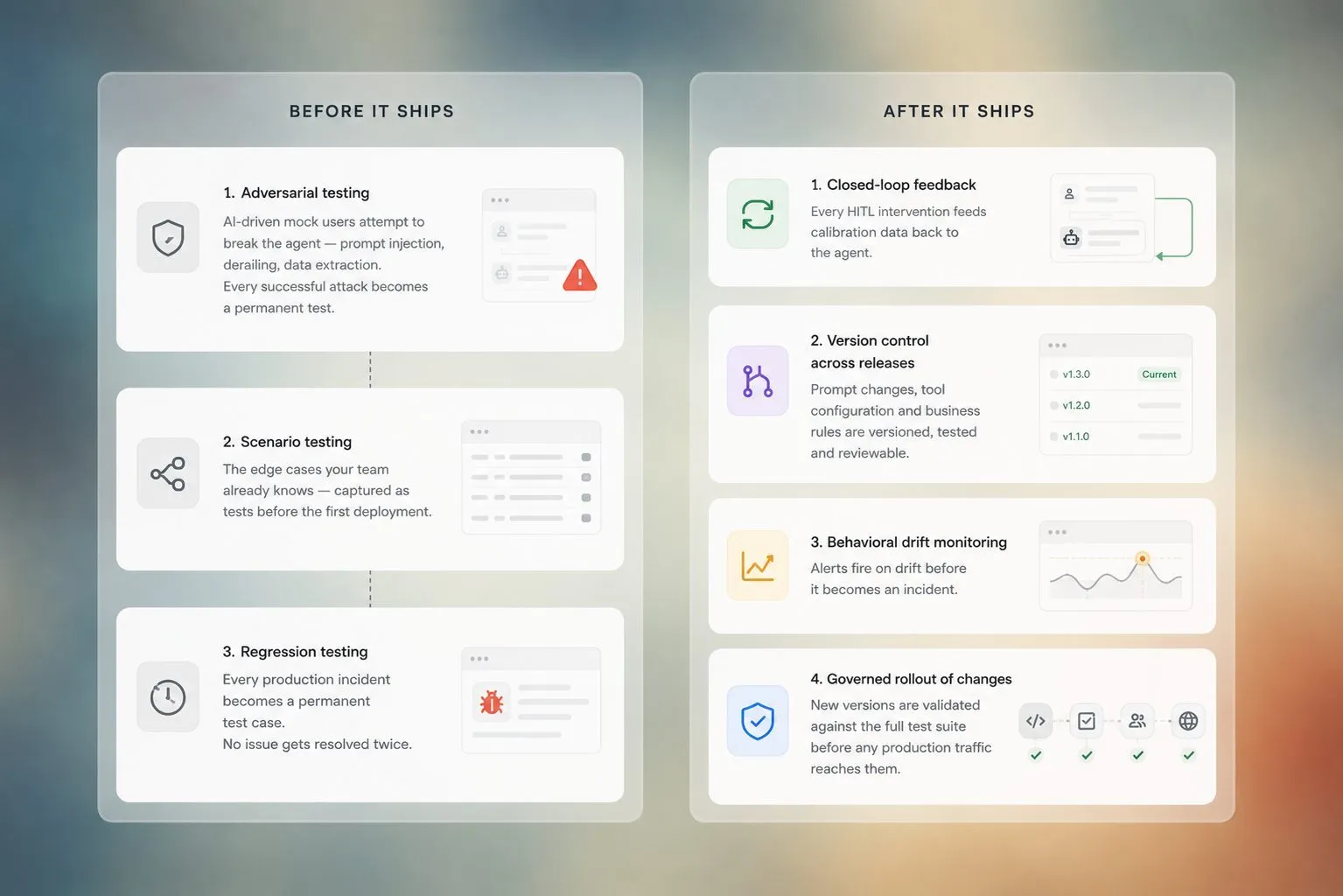
Continuously tested. Governed at every stage.
Before deployment, every agent is tested against adversarial attacks, known scenarios and regression cases. After deployment, human feedback, behavioral drift and production incidents feed back into the Governance Envelope, under version control, continuous review and governed rollout.
Concrete evidence
Every production deployment includes.
These governance controls are agreed with your Legal team in the project specification, verifiable by audit, in place from day one.
- decision_provenance
- enabled · retention agreed per project
- hitl_workflow
- mandatory · per_operation
- audit_trail
- iso27001_aligned
- approval_workflow
- configured
- right_to_erasure
- traceable · logs + memory + embeddings
- confidence_threshold
- per_agent · per_operation
- continuous_authorization
- enforced
- test_case_traceability
- specification_to_delivery_report
- regression_suite
- every_release
The Governance Envelope, agreed per project. Verified, not assumed, re-checked on every release. Agreed with your Legal team before go-live. Verifiable by audit after. Related security controls live in Security & Reliability →
Get in touch
Talk to us and get started.
Book 30 minutes with our team. Walk us through your process. We'll show you where AI agents can make a difference.