

Product · Integration
Enterprise connectivity for autonomous operations.
- +100Clients · 16 countries
- 6Architectural patterns
- Your cloudDedicated subscription per client
The approach
Integration is an engineering decision.
The right mechanism for each system depends on its constraints: latency, security posture, data ownership and the operational risk of each interaction. A modern SaaS API, an ERP-native SDK, an industrial event stream and an RPA fallback carry distinct guarantees, failure modes and maintenance profiles.
We select the pattern per system during discovery. Not before. Not by default.
Architectural patterns
Every integration follows an architectural pattern.
Six patterns cover the enterprise landscape. Each carries its own tradeoffs. We match pattern to system, not the other way around, each pattern implemented once in the App Framework. See Technology →
Modern SaaS APIs
- REST
- GraphQL
- Webhooks
- Salesforce
- HubSpot
- ServiceNow
- MCP servers
The default choice when guarantees are strong and latency is acceptable.
Enterprise SDKs
- SAP RFC/BAPI
- Dynamics Dataverse
- Salesforce Bulk
Vendor-native protocols for platforms that don’t reduce to HTTP.
Event streams & real-time messaging
- Kafka
- Azure Event Hubs
- Message queues
For sub-second latency, ordered processing and resilience to bursts.
Direct data access
- Read replicas
- Warehouse queries
- Change-data-capture
When the volume or complexity of the read exceeds what an API is designed for.
Industrial protocols
- Modbus
- OPC UA
- MQTT
- Direct PLC access
For the shop floor, where the requirement is deterministic behavior.
Interface automation (last resort)
- RPA
- UI automation
- HITL-supervised
When no other interface exists. Fully audited, monitored for interface changes.
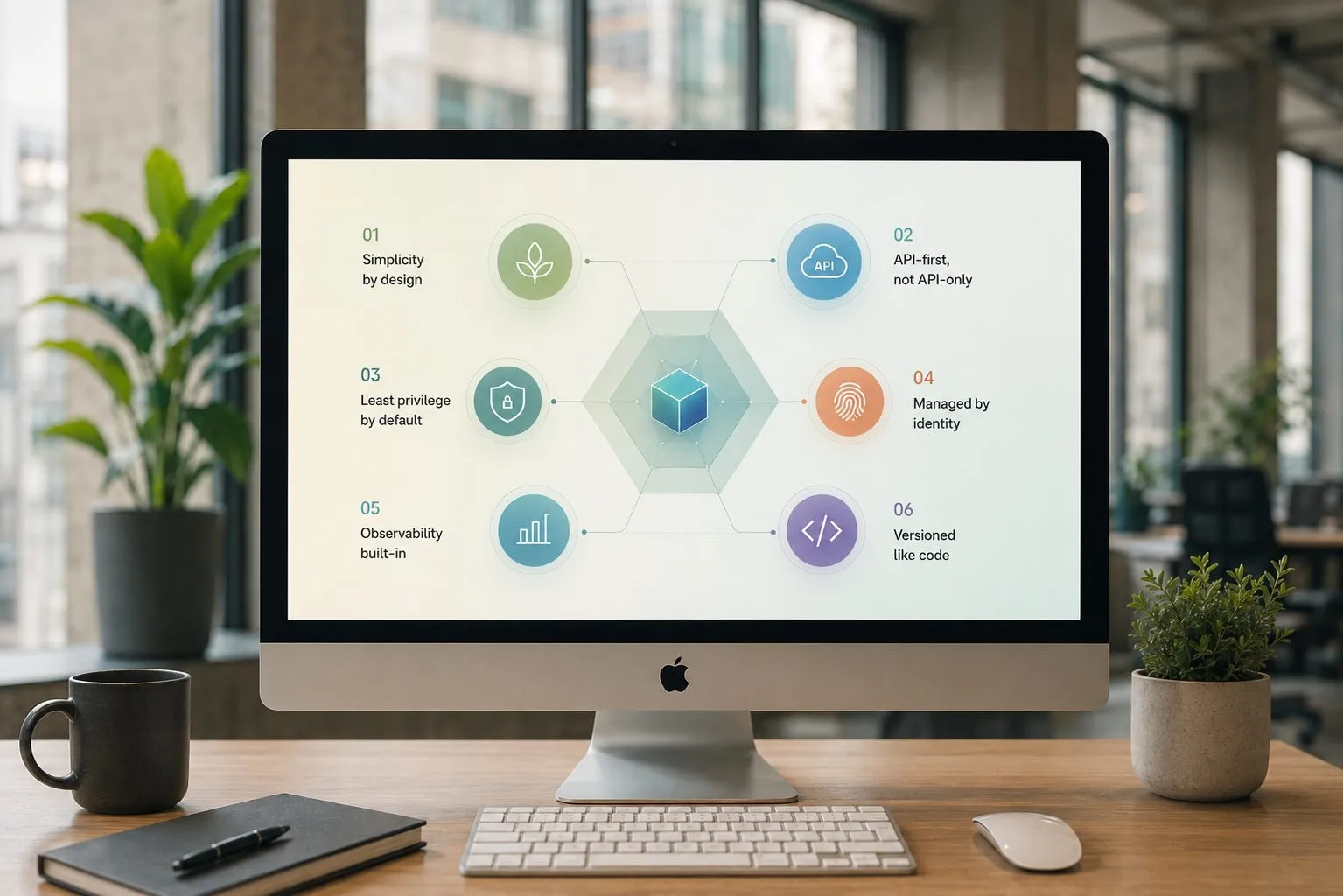
Engineering principles
Six principles that every integration follows.
The patterns describe what we build. The principles describe how we build it.
01 · Choose the simplest pattern that meets the requirement.
Complexity is a cost, in latency, in maintenance, in the surface area for failure.
02 · API-first, but not API-only.
Where a modern API exists, it’s the default. Where its guarantees fall short, other patterns take over as deliberate choices.
03 · Least privilege by default.
Access scoped to the minimum required. Write access declared explicitly, per operation.
04 · Managed by identity, not by static credentials.
Every integration authenticates through the customer’s identity system. Tokens are short-lived and scoped per agent.
05 · Observability is a requirement, not a feature.
Calls, responses and retries instrumented from day one, it’s the only way to operate a system in production.
06 · Versioned like code, because it is code.
Adapters, scopes and connection patterns live in source control. Changes go through review. Deployments are reversible.
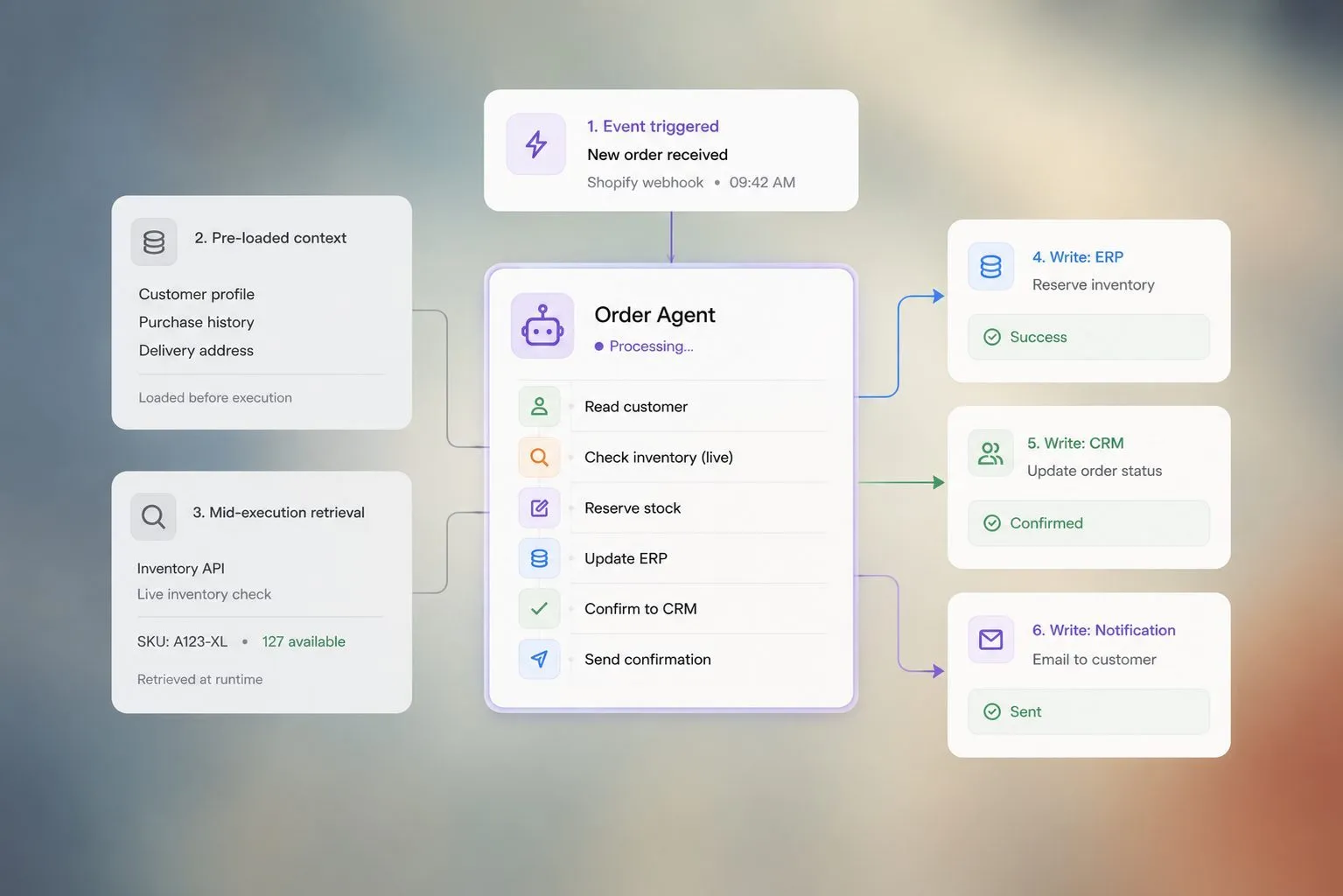
Data flows
What flows, when, and in which direction.
Two orthogonal decisions (the direction of data and the moment it moves) declared explicitly, per agent, per system.
Read, write, bidirectional
The agent reads records, writes transactions, and in bidirectional flows queries, decides, acts and verifies, coordinating across systems in a single execution.
Pre-loaded context
Data pushed into the agent before execution begins: a customer record, a case history. The agent starts a task already knowing what it needs to know.
Mid-execution retrieval
Data that isn’t known until the process is underway: a live inventory check, a real-time price. Retrieved at the exact moment it becomes relevant.
Event-triggered execution
The integration itself starts the agent. A new ticket, a status change, a webhook payload: the triggering event becomes the agent’s first context.
Integration lifecycle
Integration doesn’t end when the API works.
It begins there. Every integration follows the same six-stage lifecycle.
- 01
Discovery
Map the system, choose the pattern.
- 02
Access design
Scope and identity reviewed with your IT.
- 03
Build & validation
Unit-, contract- and live-tested.
- 04
Deploy & monitor
Observability from the first call.
- 05
Versioning
Tracked, reversible, zero-downtime.
- 06
Maintenance
API drift handled under maintenance.
Integration is a system that runs. Not a build that ships.
The discipline
We don’t ship connectors. We ship the engineering discipline that makes them reliable.
Every integration in a Machines Like Me deployment follows the same patterns, the same principles, and the same lifecycle, because that’s how autonomous operations stay autonomous in production.
Get in touch
Talk to us and get started.
Book 30 minutes with our team. Walk us through your process. We'll show you where AI agents can make a difference.